
Education is about helping students to recognize the value of the blank pages in their growth. Guess what, parenting needs blank pages, too!
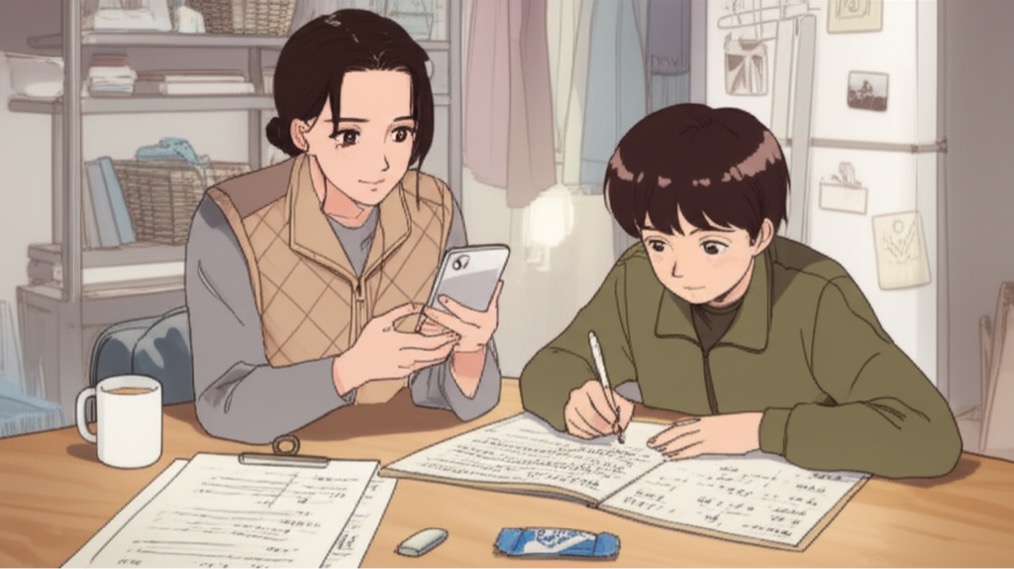
My son Rintaro is studying for his high school entrance exams, so my wife is working with him on math, which he’s not good at. He has terrible handwriting, so his messy numbers get in the way of getting the right answers. Yesterday, my wife said, “This equation is a story, so to speak, leading up to the answer. So, write that story clearly and beautifully so the reader can understand it. You can’t arrive at the answer without telling your own story.” I think you have heard the different kinds of explanations to teach kids the importance of “showing their work” before the answer.
The math teacher used to say, “Show me your work,” at the American middle school where I taught. We taught students the importance of not just writing down the answer, but also “showing the process and explaining it logically.” In fact, even in graduation exams, when the teacher asked students to “verbally explain how to solve it” rather than “solve this equation,” students who didn’t do so well in math but who had practiced the steps a lot were better at explaining logically than students who routinely said, “I already know the answer, why do I have to write down the steps?”
I work with parents. Some are tired of searching for the “right answer” in parenting. Others don’t care about “how” to do it. Some parents are cost-conscious and only want to know “what will happen” if they do it. And others worked hard to develop their own steps to their answers. We would probably just write down the “answer” if the answer column on an answer sheet were very small. What if there were 10 blank pages attached before the answer column? We would not just write “answer” in the small square box on the last page, right? We would use those blank sheets to write steps and thoughts that lead to the answer.
Would you understand the answer if you knew just the answer? Most importantly, would you understand the steps to arrive at the answer just by knowing the answer? Would you really be able to understand the process of getting there? Use blank pages! Don’t copy and paste someone’s steps in those blank pages. It has to be your steps! No matter how many times you ask around and put together someone’s “correct answer,” you won’t arrive at “your answer.” The breadth of parenting lies not in the correct answer column, but in the process column.
In Japan, I hear, “there’s no right answer when it comes to raising children.” It is one of the comforting phrases for parents who are struggling to raise kids. Some start arguing with their own opinions. “But, you know…” “There’s no right answer when it comes to raising children,” but what ideas follow after that statement? Your “but, you know…”
“But, you know, there is ‘my’ answer. And the ‘process’ of getting there is what’s exciting about parenting!” is my idea.
Show the process. That might mean you can get partial credit even if the answer is wrong. I want to raise my children in a way that values partial credit. That’s because I want to teach them to value the process and to give fair, proper evaluations along the way. Whatever the outcome, the story is adventurous, and its ups and downs make it remarkable.
We need to value the way we parent and the process of our growth as parents, and give ourselves fair credit along the way. I think it would be best to say something like, “I’m sure we are doing something together with my kids that has a positive influence on mychild. I’ll give myself partial credit for that!”
There is no right or wrong way to raise children, but partial credit is fun and amazing. Whatever the outcome, the story should be worth reading.

 今瀬博の教育と子育てと冒険話・Words of wisdom: Education, Parenting and Adventure